Airstream has always moved purposefully forward: not change for the sake of change, but advances to make travel easier.
As Airstream celebrates 95 years of business in 2026, a tradition of innovation continues to drive the company. Today, Airstream leads the RV industry in one of the most important areas of innovation – power independence. With off-grid powerhouses like the Trade Wind lineup and Basecamp 20Xe, Airstream’s never-ending quest to improve our products lets owners venture farther and stay longer than ever thought possible. Large lithium battery capacity, expansive solar options, and powerful inverters give Trade Wind and Basecamp 20Xe owners the ability to run air conditioning, microwaves, and interior appliances and charge devices far from the traditional campground.
Airstream Innovation in 2026–and Beyond
Trade Wind
:quality(85):smart(true))
Airstream continues to push off‑grid capability forward with models like Trade Wind, which features significantly expanded battery capacity, rooftop solar, and powerful inverters. The 23FB and 25FB come equipped with 3,000‑watt inverters, while the new 27FB steps up to a 6,000‑watt inverter—enough power to run major appliances like the air conditioner and microwave, charge devices, and stay connected wherever you roam.
Because every outlet in Trade Wind is tied to the inverter circuit, the entire trailer becomes usable off grid. (In most other models, only about half the outlets are on the inverter circuit, meaning they don’t supply power unless the inverter is on.) Combined with its large battery bank and solar array, Trade Wind delivers a seamless, shore‑power‑like experience even far from the campground.
:quality(85):smart(true))
Trade Wind
Designed for modern adventurers, Trade Wind combines impressive off-grid capability with the comfort and craftsmanship Airstream is known for.
Basecamp 20Xe
:quality(85):smart(true))
Likewise, Airstream’s adventurous line of Basecamp Travel Trailers features an off-grid powerhouse in the Basecamp 20Xe. With similar capability to the Trade Wind lineup, Basecamp 20Xe delivers an all-electric-capable design that gets owners farther than ever from traditional hookups.
Built for unrestricted adventure, the Basecamp Xe combines exceptional off-grid capability with Airstream’s legendary handcrafted quality and the comforts of home. Expanding on the popular Basecamp 20 platform, it comes equipped with 600W of rooftop solar, a 10.3kWh Battle Born® lithium battery pack, and a 3,000W inverter. Its fully inverted electrical system powers every outlet directly from the battery bank and supports all trailer functions, including the optional air conditioner and optional microwave, even when you're far from hookups. Designed for the flexibility and freedom Airstream travelers expect, the trailer also includes a 20-pound propane tank that enables outdoor grilling while serving as a backup fuel source for both the furnace and hot water heater.
But Airstream’s story of innovation is not contained to the present–it’s a tradition that began when Wally Byam first started building recreational vehicles a century ago.
:quality(85):smart(true))
Basecamp Xe
With advanced power technology and off-grid capability, Basecamp Xe is ready for adventure wherever the journey leads.
A Century-Long Tradition of Innovation
Airstream’s story of innovation begins in the early 1920s, when Wally Byam set out to make camping more comfortable for his wife Marion. His first attempts—a Model T chassis topped with a tent, then a wood-sided teardrop trailer with sleeping space, a stove, and an ice chest—quickly drew interest from fellow travelers. By 1929, Wally was building trailers for neighbors and opened a small California factory. He named his creations “Airstreams” because they moved “like a stream of air” down the road, embracing the streamlined industrial design of the era.
Throughout the 1930s, Wally refined his Masonite‑built Silver Cloud trailers, but he knew aluminum could take the concept further. In 1936, he introduced the Clipper, the first riveted aluminum Airstream—sleek, aerodynamic, and engineered with increasingly sophisticated features. Production paused during World War II, when aluminum became a strategic material and Wally worked in the aircraft industry. That experience shaped the post‑war Airstreams he launched in 1947, supported by a passionate team and promoted with iconic marketing moments like Alfred Letourneur towing an Airstream by bicycle.
:quality(85):smart(true))
First Self-Contained RV
Innovation accelerated through the 1950s, culminating in the 1958 International—widely considered the first self‑contained RV. With holding tanks, propane water heaters, refrigerators, and torsion suspensions designed for off‑grid travel, Wally even prototyped the model on his Africa Caravan. Airstream continued studying aerodynamics through the present day, with a 2021 study showing that its trailers produced 20–25% less drag than box‑style RVs and reinforcing the brand’s belief that streamlined design improves efficiency and freedom on the road.
eStream: Eyes on the Future of Design Technology
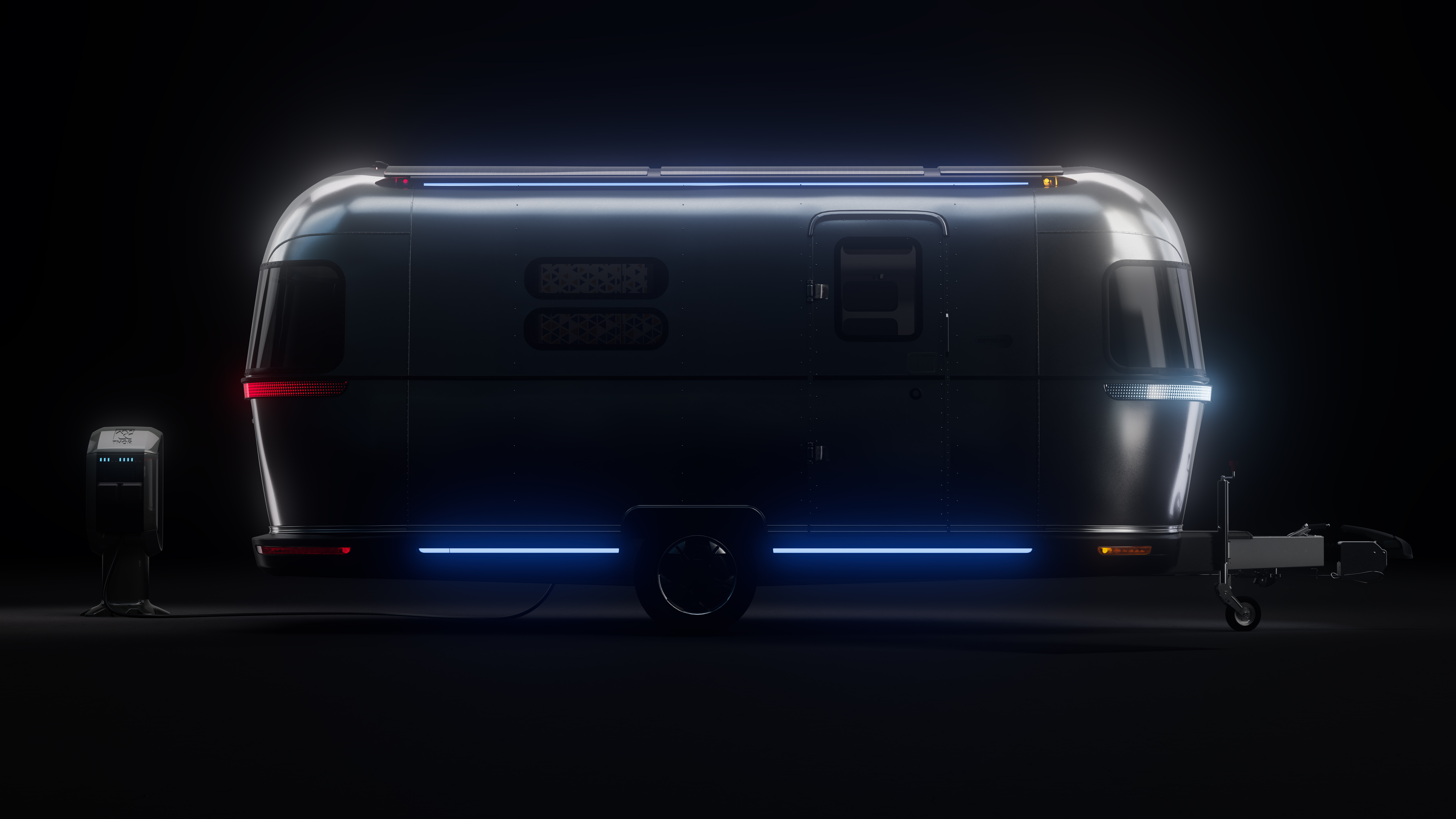
More recently, the eStream Concept Travel Trailer represents Airstream’s bold vision for the future of RV travel. First revealed in 2022, this all‑electric concept was developed with THOR Industries to explore how next‑generation mobility, efficiency, and off‑grid capability could reshape the travel experience. With advanced aerodynamics, ultra‑efficient solar, and a high‑voltage battery bank, the eStream imagines a world where a travel trailer actively assists the tow vehicle to maximize range, can be maneuvered remotely into a campsite, and supports longer, more comfortable off‑grid stays without generators or shore power.
At the heart of the eStream is a large automotive‑grade battery system that powers all‑electric appliances and dual motors capable of moving the trailer under its own power. In Drive Mode, those motors help propel the trailer in concert with the tow vehicle, reducing strain and improving efficiency. In Living Mode, the 80‑kWh battery bank delivers an experience similar to being plugged into shore power—running the air conditioner, appliances, and entertainment systems far from traditional hookups. Inside, a modern 22‑foot floor plan provides sleeping space for four, a wet bath, and a fully electric galley.
The eStream builds on Airstream’s long legacy of pushing boundaries, echoing the spirit of Wally Byam’s 1958 International—the first fully self‑contained travel trailer. Just as that breakthrough redefined independence on the road, the eStream points toward a future of cleaner, easier, more efficient travel. While still a concept, its technologies and ideas are already influencing Airstream’s core models, shaping a new era where travelers can go farther, stay longer, and enjoy greater comfort with fewer limitations.
:quality(85):smart(true))
Exploring the Possibilities with Porsche Design
Just a few years ago, Airstream partnered with Studio F. A. Porsche to explore a bold “what if” scenario for the future of RV travel. The result was the ultralight, garageable Airstream Studio F. A. Porsche Concept Travel Trailer design, unveiled at SXSW. The concept blends Airstream’s iconic design DNA with Porsche’s modern design philosophy, reimagining how a travel trailer can look, function, and fit into the lives of a new generation of travelers.
This collaboration introduces several firsts in Airstream history, including an adjustable suspension that lowers the trailer enough to fit inside a standard residential garage and raises improved aerodynamics for off‑road capability. A carbon‑fiber pop‑up roof adds 12 inches of headroom when camping while maintaining a low profile in tow. Extensive aerodynamic testing refined the shell’s shape, relocated drag‑inducing components inside the chassis, and created a flush underside and new rear profile that shed air more efficiently.
Inside, the design prioritizes flexibility and connection to the outdoors. A two‑piece rear hatch opens the living space, while a convertible rear seating area transforms from lounge to workspace to a large sleeping area. Skylights, windows, and a cleverly engineered wet bath maximize space and light, and the extended galley creates an L‑shaped workspace comparable to larger trailers. Every element reflects Porsche’s respect for Airstream’s heritage while pushing the brand into new territory.
Whether this concept will ever become a production model remains unknown, but its influence is certain. Like past design studies—including Airstream’s 2002 collaboration with Nissan that helped inspire the Basecamp—the Studio F. A. Porsche project serves as a proving ground for ideas, materials, and engineering approaches that can shape future Airstream products. It stands as a vivid example of how Airstream continues to innovate by imagining what’s possible next.
:quality(85):smart(true))
Aerodynamics
Airstream’s history with aerodynamic design and commitment to aerodynamic improvements goes back to the start of the brand, when Wally named the company Airstream and said he wanted to design a travel trailer that would flow down the road like a stream of air.
Airstream’s most recent aerodynamic research took place in 2021 at the world class Auto Research Center in Indianapolis, where engineers used advanced wind‑tunnel testing to refine how cleanly a trailer moves through the air. The team began with computer‑animated models to identify areas for improvement, then built quarter‑scale prototypes that allow quick adjustments and rapid testing cycles. This process confirmed what decades of experience have already shown: Airstreams are inherently efficient towing travel trailers—but there’s always room to push performance further.
:quality(85):smart(true))
Aerodynamics matter because they directly shape the travel experience. Better airflow can improve fuel economy, provide longer range for electric tow vehicles, and result in fewer interruptions on the road. It’s ultimately about freedom—helping travelers go farther on a tank of gas or a battery charge and reducing the stress of resource consumption. Curves remain one of Airstream’s greatest aerodynamic advantages, a design element rooted in the company’s DNA since Wally Byam’s aircraft‑inspired innovations during and after World War II.
As Airstream looks to the future, a continued focus on aerodynamics will build on that legacy, driven by both economics and the rapid rise of electric tow vehicles. Airstream engineers are analyzing every detail—smoothing surfaces, streamlining components, and refining shapes—to ensure each incremental improvement enhances efficiency and the overall towing experience. As the industry evolves, Airstream remains committed to leading the charge, continuing to push boundaries and elevate what’s possible on the open road.
More Committed Than Ever Today
From Wally’s first homemade trailer to electric‑forward concepts like eStream—and from aerodynamic breakthroughs to modern off‑grid systems—Airstream’s history forms a clear through‑line. The brand has always pushed boundaries, tested new ideas, and redefined what mobile living can be. Innovation isn’t a chapter in Airstream’s story; it’s the thread that connects every generation of design, engineering, and adventure.
:quality(85):smart(true))
Combining advanced off-grid capability with the comfort and quality Airstream is known for, Trade Wind is ready for modern adventures of every kind.
:quality(85):smart(true))
Built for those who love to explore, Basecamp Xe pairs advanced power technology with off-grid capability so you're ready for adventure wherever the journey leads.